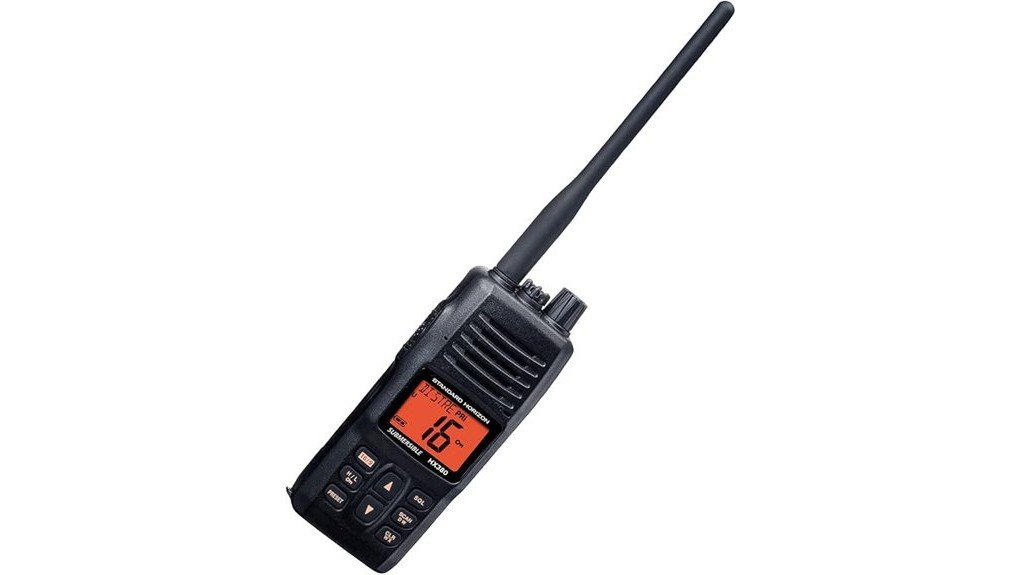
You’ll get a tough, waterproof VHF that’s simple to use and built for boats and workboats. It’s dealer‑programmable with marine plus 40 LMR channels, has a clear 1.5″ display, and delivers about 13 hours from the 1650 mAh Li‑Ion pack. Expect usable line‑of‑sight range to roughly 15 km in ideal conditions, 700 mW audio for noisy decks, and IPX7 submersibility. If you want specifics on operation, mounting, and alternatives, keep going.
Some Key Takeaways
- Reliable marine VHF with dealer-programmable 40 LMR channels across 134–174 MHz for quick, accurate frequency setup.
- Clear 1.5″ LCD and intuitive front-panel controls enable straightforward operation and fast channel scans.
- IPX7 submersible housing, corrosion-resistant materials, and sealed controls suit harsh saltwater environments.
- 1650 mAh battery yields about 13 hours runtime; optional alkaline tray and accessory compatibility add flexibility.
- Modest clear line-of-sight range (~15 km ideal) and 700 mW audio provide intelligible comms, though range is obstacle-dependent.
Performance and Range Tested: Real-World VHF Range, Audio Clarity, Battery Life, and Waterproof Use Cases
When you take the Standard Horizon HX380 out on the water, it delivers predictable VHF performance: dealer-programmable marine and 40 commercial LMR channels across 134–174 MHz give clear line-of-sight range up to about 15 km in ideal conditions, and the 700 mW audio keeps transmissions intelligible in wind and engine noise. You’ll assess signal propagation empirically—expect range to drop with obstructions and sea state. Antenna performance matters: mount height and orientation change reach more than power. Battery life of about 13 hours supports long watches. IPX7 resistance means you won’t hesitate to use it in wet, shared cruising crews. When choosing a handheld marine radio, consider battery life and waterproofing as two essential factors for safe, reliable boating.
What’s in the Box and Key Specs at a Glance: HX380 Battery, Accessories, Frequencies, IPX7, Weight, and Compatibility
Although it’s compact, the HX380 ships with everything you need for immediate use: the radio fitted with a 1650 mAh Li‑Ion battery (≈13‑hour run time), a belt clip, a charging cradle/AC adapter, and the user guide, with an optional FBA‑40 alkaline tray available separately. You get marine plus 40 LMR channel coverage (134–174 MHz) and dealer programmability. IPX7 waterproofing and a 1 lb weight make it rugged and portable. Accessory compatibility includes speaker mics and headsets; check connectors before buying. Follow simple battery maintenance—regular charging cycles and storage rules—to preserve lifespan. This kit keeps you mission-ready and connected. Essential Gear for Safer and Smarter Boating is a helpful resource for finding compatible marine VHF accessories and related products.
Ease of Use and Programming: Display, Channel Naming, Dealer Programmability (Marine + 40 LMR), Controls, and Accessory Support
You’ll get a straightforward, task-focused interface: the oversized LCD shows channel names clearly, front-panel controls give direct access to channel up/down, scan and power, and dealer programmability lets technicians load both marine channels and 40 commercial LMR frequencies (134–174 MHz) to match your deployment. You’ll appreciate clear channel labeling on the 1.5″ display and simple menu navigation for quick status checks. Physical buttons reduce accidental inputs and speed routine ops. Dealer programming means you don’t wrestle with complex frequency maps. Accessory compatibility (speaker mics, headsets, FBA-40 tray) integrates seamlessly so your team feels equipped and included. Essential emergency radios for safe boating adventures are a critical part of any boat’s safety gear, so consider models that are built for marine use and emergency readiness.
Durability and Marine Readiness: Submersible Rating, Build Quality, and Suitability for Boating and Harsh Conditions
Count on the HX380 to stand up to marine abuse: it’s built submersible to IPX7 standards, so you can drop it overboard or expose it to heavy spray without losing function. You’ll appreciate the rugged housing and sealed controls that prevent water ingress and keep buttons reliable. Corrosion resistance is handled through marine-grade materials and coatings for exposed metal, extending service life in salt environments. Battery seals and connectors stay tight under repeated wet/dry cycles. Mounting options are straightforward—belt clip, bracket, or lanyard—so you can secure the radio where crew access and safety demand it. It pairs well with other gear commonly recommended for boaters, including waterproof flashlights, to keep essentials accessible and protected on deck.
Who Should Buy the HX380 and Alternatives to Consider: Ideal Users, Pros vs Cons, Price Positioning, and Comparable Radios to Weigh
With its IPX7 submersibility and rugged, corrosion-resistant construction, the HX380 suits boaters and marine professionals who need a reliable, no-frills VHF that survives spray, drops, and salt exposure. You’ll appreciate long term durability, 13-hour battery life, and clear 700 mW audio for onboard comms and emergency signaling. Buy it if you want simple operation, channel programmability, and optional alkaline backup. Downsides: basic display, modest range, and minimal extras. Price sits midrange for dependable handhelds. Consider alternatives like Icom IC-M25, Standard Horizon GX1600, or Yaesu FTA-250L depending on features, pricing, and accessory needs. The site also offers other weather radio products and resources for boaters looking to Stay Safe at Sea.
Some Questions Answered
Is the HX380 Compatible With DSC or GPS Integration?
No — the HX380 doesn’t support DSC compatibility or direct GPS integration. You’ll need a DSC-capable radio and external GPS to get distress calling and position transmission. If you want those features, pair your setup with a compatible base or handset that supports DSC and NMEA GPS input, or choose a different handheld with built-in DSC/GPS. You’ll still belong to a safe marine communications ecosystem by choosing interoperable gear.
Can the Radio Be Programmed by End Users Without Dealer Tools?
No — you can’t fully program dealer-only channels without dealer tools. You can adjust many settings and add some custom channels within user limits via the radio’s front panel, but dealer-programmable marine and commercial LMR allocations require proprietary software or dealer access. If you want expanded channel sets, coordinate with an authorized dealer or service; they’ll help you add custom channels beyond the radio’s built-in user limits.
What Accessories Are Sold Separately by Standard Horizon?
Standard Horizon sells spare batteries, mounting brackets, plus speaker microphones and headsets as separate accessories. You’ll want spare batteries for extended trips and mounting brackets to secure the unit aboard. You can also add optional alkaline battery trays, speaker‑mics, and compatible headsets for hands‑free use. You’ll feel supported in the community when you outfit your radio with these practical, dealer‑compatible accessories that keep you mission‑ready and connected.
Does the HX380 Include NOAA Weather Alerts?
Yes — you’ll get NOAA reception and programmable Alert settings on the HX380. You can tune NOAA weather channels and enable weather alerts so the radio monitors emergency broadcasts. With adjustable Alert settings you’ll control tone and channel priority, keeping your group informed when conditions change. It’s practical, straightforward, and designed so you and your crew can rely on timely weather warning signals while out on the water.
Are Firmware Updates Available and How Are They Applied?
Yes, firmware availability is limited; Standard Horizon releases occasional updates. You’ll check the manufacturer site or contact support for the latest firmware and release notes. The update procedure requires a PC, the radio’s programming cable or authorized service tool, and the vendor’s updater software; you’ll download the firmware file, connect the HX380, run the updater, and follow prompts. You’ll verify version afterward and keep backups when possible.