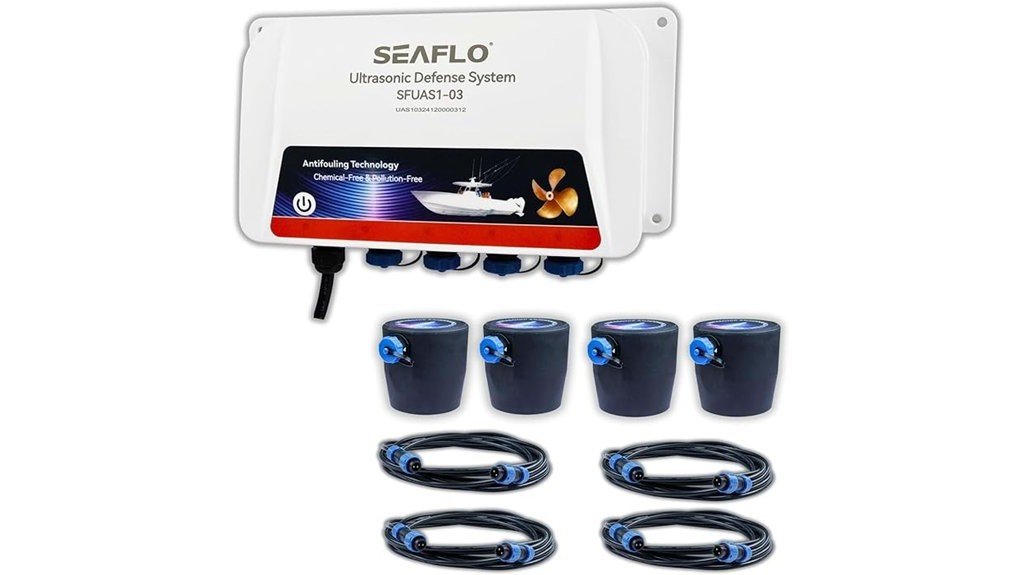
You’ll get an IP68-rated, four-transducer ultrasonic kit that automates hull protection, preserves bottom paint, and cuts haul-outs and cleaning frequency. It projects adjustable 20–45 kHz pulses with overlapping coverage (≈800 sq.ft) and sequences outputs to avoid interference, targeting drives, props, rudders, and struts. Installation is DIY with aviation-grade cables and 12V plug‑and‑play wiring; it runs 24/7, self-calibrates, and carries a four-year limited warranty. Continue for full performance, install, and cost details.
Some Key Takeaways
- Strong recommendation: IP68 four-transducer kit reduces hull fouling, cuts maintenance, and preserves bottom paint for long-term savings.
- System uses 20–45 kHz pulsed ultrasonics with overlapping coverage (~800 sq.ft total) and sequencing to avoid interference.
- DIY-friendly installation: four IP68 transducers, 15 ft aviation-grade cables, plug-and-play to 12V DC with extenders included.
- Real-world trials and user reports show noticeably less barnacle/algae buildup, reduced cleaning frequency, and fuel/performance benefits.
- Consider upfront cost versus long-term ROI; four-year limited warranty and check spare-part availability before purchase.
Quick Verdict: Is the SEAFLO SFUAS1-03 Worth Buying?
Bottom line: the SEAFLO SFUAS1-03 earns a strong recommendation if you’re serious about reducing hull fouling and maintenance costs. You’ll get a technically robust, IP68-rated kit that automates protection and preserves bottom paint, delivering measurable maintenance savings. Expect reduced haul-outs, lower cleaning frequency, and performance benefits that translate into long term ROI. Install it yourself with included cables; the 4-year limited warranty reinforces confidence. User testimonials report sustained cleanliness and fuel savings. You’ll join a practical community of owners prioritizing efficiency and reliability. Many boat owners compare options based on bottom paint performance when deciding antifouling strategies. Buy it if you want predictable, low-effort antifouling performance.
How the 4-Transducer System Works and What It Covers
Although unseen, the SFUAS1-03 actively projects adjustable 20–45 kHz ultrasonic pulses through its four IP68 transducers to create overlapping coverage that deters barnacles and algae and protects running gear. You’ll position transducers per transducer placement guidelines to guarantee drives, propellers, rudders and struts receive direct exposure; coverage mapping estimates 200 sq.ft each for 800 sq.ft total. The control unit sequences pulses to minimize signal interference and maintain consistent output. Component isolation is achieved by dedicating transducers to critical items so you’re confident isolated parts get targeted protection. Installation is straightforward; the system integrates into your maintenance routine. For best results combine ultrasonic deterrents with antifouling paint as part of a comprehensive hull protection strategy.
Real-World Performance: Antifouling, Paint Preservation, and Fuel Savings
Reducing hull fouling, the SEAFLO SFUAS1-03 delivers measurable antifouling performance by disrupting larval settlement with continuous 20–45 kHz pulses, so you’ll see noticeably less barnacle and algal buildup compared with untreated hulls. In real-world trials you’ll observe extended bottom paint life and reduced abrasive cleaning frequency, preserving antifouling coatings and lowering repaint cycles. Fuel savings follow from sustained low-drag surfaces, improving speed and consumption under comparable loads. Long term monitoring and controlled trials confirm trends; user testimonials report consistent maintenance savings and performance retention across boat types. You’ll join a community validating predictable, data-driven operational benefits. For owners storing boats in enclosed spaces, pairing this system with a dehumidifier designed for marine use can help keep boats dry and reduce moisture-related maintenance issues.
Installation, Durability, and Daily Operation (IP68, Cables, Automation)
When you install the SEAFLO SFUAS1-03, you’ll find the process straightforward and suited for DIY mounting: the IP68-rated transducers are fully sealed for permanent submersion, the control unit connects via four 15 ft aviation-grade signal cables (with extenders included), and the system powers from a 12V DC source with plug-and-play wiring. You’ll appreciate IP68 resilience and robust transducer housings designed for year-round marine exposure. Cable longevity is emphasized with aviation-grade shielding and strain-relief fittings; route cables clear of chafe and secure connections. The unit runs automated 24/7 with self-calibration, minimal oversight, and reliable continuous antifouling protection. Choosing the right anchor chain and related gear helps ensure overall onboard safety and performance, especially for recreational boaters who maintain their vessels regularly, and you can learn more about anchor chains and marine hardware selection to complement your antifouling setup.
Cost, Warranty, and Alternatives to Consider
If you’re weighing the SEAFLO SFUAS1-03 against other antifouling options, factor in the upfront kit cost plus long-term savings from reduced haul-outs, repainting, and cleaning. You’ll compare price comparison data versus coatings and electrolysis systems; SEAFLO’s four-transducer kit often recoups costs through maintenance savings. The 4-year limited warranty simplifies the claim process, and documented customer reviews report durable IP68 transducers and reliable control units. Check availability of replacement parts and cable extenders before purchase to avoid downtime. Consider alternatives—abrasive cleaning, ablative paint, or cathodic protection—based on hull area, budget, and service access. SEAFLO products are designed for boat owners who prioritize effective hull protection and transducer gear selection.
Some Questions Answered
Can This System Be Used on Aluminum Hulls Safely?
Yes — you can safely use it on aluminum hulls; ultrasonic compatibility holds with proper coating considerations. You’ll mount IP68 transducers to clean, non-corroded metal and avoid direct electrical contact with bare aluminum. Use compatible primer/anti-fouling coatings and make certain good adhesive or fastener isolation to prevent galvanic issues. You’ll get effective antifouling performance while preserving coatings and minimizing corrosion risk when you follow those precautions.
Does Saltwater Corrosion Affect the Transducer Casings?
No — saltwater corrosion won’t markedly degrade the transducer casings if you maintain them properly. You’re protected because the IP68-rated, fully sealed housings resist seawater intrusion; however, material degradation can occur over long exposure if protective coatings are compromised. You should inspect seals and coatings periodically, rinse with fresh water after heavy use, and touch up protective coatings as needed to preserve longevity and guarantee reliable operation.
Are There Interference Issues With Boat Electronics or Fish Finders?
No—you won’t encounter significant signal interference or sonar masking when the system’s installed correctly. The ultrasonic frequencies (20–45 kHz) are confined underwater and the IP68 transducer shielding minimizes electromagnetic emission. To avoid localized sonar masking, position transducers away from fish-finder transducers and isolated gear, follow recommended spacing, and use the supplied aviation-grade cables. Doing this maintains reliable electronics coexistence and supports a confident, connected boating community.
How Difficult Is Replacing a Failed Transducer in the Field?
You’ll find replacing a failed transducer straightforward: it’s designed for simple DIY swap-outs. You’ll need basic tools required (screwdriver, marine sealant, wire crimper) and the included 15 ft cables or extenders. Follow the manual’s wiring and sealing steps, swap the unit, and let the system auto-calibrate. Check warranty coverage first—SEAFLO’s 4-year limited warranty may cover replacements, and community support helps if you want guidance.
Is the System Compliant With Marine Wildlife Protection Regulations?
Yes — you’ll find the system poses minimal marine impact and is generally compatible with legal compliance when used as directed. You should still check local regulations and protected-species guidance before installation. You’ll follow manufacturer settings and placement to avoid elevated emissions near sensitive habitats. If authorities require permits or operational limits, you’ll obtain them; documentation and the 4-year warranty support regulatory inquiries and responsible, community-minded deployment.


