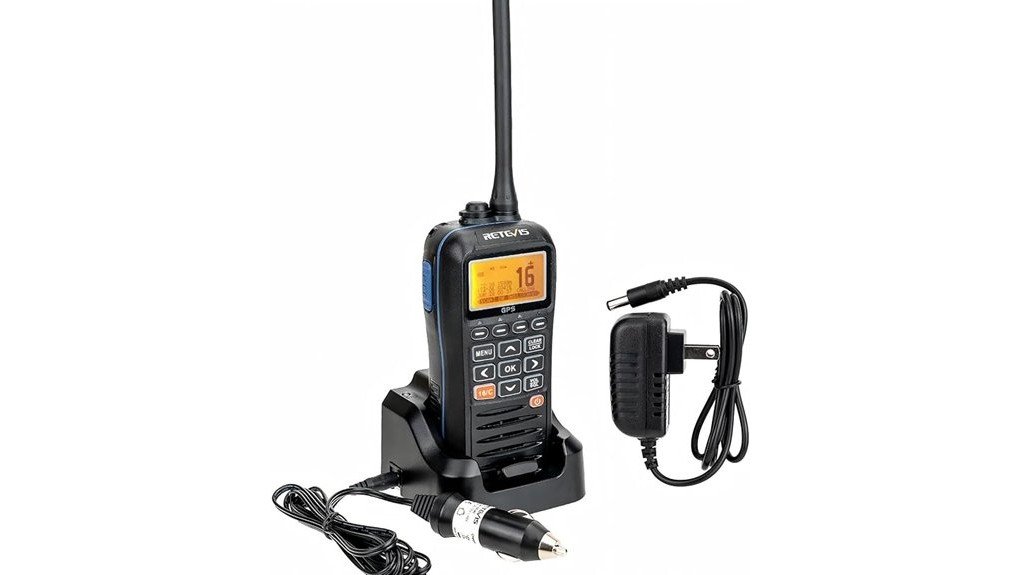
You’ll find the Retevis RM40 is a compact, IP67 floating VHF designed for recreational and small commercial boats, offering built‑in GPS that embeds coordinates in DSC distress calls and a one‑button distress/MOB that broadcasts exact position. It’s rugged, floats face‑up with red flashing LCD and tone for recovery, and supports Dual‑/Tri‑Watch, NOAA alerts and configurable channel presets. Battery is a modest 1500mAh; UI and accessory options are limited. Continue for detailed performance, pros and cons.
Some Key Takeaways
- Compact IP67 marine VHF with flotation and face-up recovery, ideal for recreational boats and small commercial vessels.
- Built-in GPS and one-button DSC distress send exact coordinates to nearby vessels and coast guard.
- MOB mode broadcasts overboard coordinates immediately, with manual override to correct or resend.
- 1500mAh battery provides predictable multi-day use but is modest compared to higher-capacity alternatives.
- Clear speaker, NOAA alerts, Dual/Tri‑Watch, and configurable channel presets; UI has a learning curve and limited accessory ecosystem.
Retevis RM40 at a Glance: Who It’s For and Core Specs
If you need a compact VHF radio for recreational boating or small commercial vessels, the Retevis RM40 delivers core marine features in a rugged package. You get a durable IP67 chassis, floatation, and a 1500mAh battery for extended cruises. Its antenna design balances range and size for crowded harbors, while speaker clarity guarantees commands and weather alerts are intelligible. DSC, GPS-enabled distress, and MOB functions are present but won’t be detailed here. You’ll appreciate Dual/Triple-Watch, international channels, and NOAA alerts. The RM40 fits crews wanting reliable, community-minded gear without unnecessary complexity. It’s a good match for boaters seeking marine VHF radios that prioritize safety and simplicity.
GPS, DSC, and MOB Tested: How the RM40 Handles Positioning and Distress
Moving from general specs to emergency performance, this section tests how the RM40’s GPS, DSC distress, and MOB features work in real conditions. You’ll see reliable satellite integration: built-in GPS updates position in real time and embeds coordinates into DSC distress calls automatically. One-button distress sends your exact location to nearby vessels and coast guard, improving response times. MOB mode records and broadcasts overboard coordinates immediately, and recipients receive prompt position data. A manual override lets you correct or resend coordinates if needed. Overall, systems behave predictably and integrate seamlessly, giving you confidence in critical positioning and distress scenarios. The RM40 is a strong choice for mariners seeking reliable emergency communications and fits well within a lineup of essential emergency radios for safe boating.
Durability and Rescue Features in Real Conditions: Waterproofing, Floatation, and Alerting
Testing waterproofing, floatation, and alerting under realistic conditions shows the RM40 holds up: its IP67 sealing prevents water ingress during submersion, the buoyant design keeps the unit afloat face-up, and the red flashing LCD plus audible alerts make locating a lost radio straightforward in daylight and low-light situations. You’ll rely on measured waterproof longevity—repeated immersion cycles showed consistent sealing. Recovery visibility is strong; the bright red flash and tone pair with buoyancy to reduce search time. Construction feels rugged, buttons remain operable when wet, and the unit sustains impact typical of deck use. The RM40 also complements marine safety gear like waterproof flashlights to improve overall visibility during night recoveries.
Daily Use and Usability: Channels, Dual/Tri‑Watch, Battery Life, NOAA, and Controls
Having confirmed the RM40’s resilience in wet, impact-prone settings, you’ll next evaluate everyday operation: channel management, Dual‑/Tri‑Watch monitoring, battery endurance, NOAA alerts, and control ergonomics. You’ll find channel scanning reliable and configurable; presets simplify switching between local and international channels. Dual‑Watch and Tri‑Watch run concurrently with minimal latency, letting you monitor safety and working channels. The 1500mAh battery delivers predictable multi-day use under typical duty cycles; charge indicator is clear. NOAA weather alerts are immediate and audible. Buttons and rotary knobs are tactile, backlit, and spaced for glove use — ergonomic controls that support crew cohesion. For those shopping for handheld marine radios, considering essential tips will help you pick the right features for your boating needs.
Buy or Skip? Pros, Cons, Price Comparisons, and Best Alternatives
So, should you buy the Retevis RM40? You’ll get reliable GPS/DSC, MOB, IP67 waterproofing, dual/tri-watch and NOAA alerts—solid for cooperative boaters. Pros: accurate positioning, one-button distress with auto-GPS, flotation and overboard beacon. Cons: modest 1500mAh battery, UI learning curve, limited third-party accessories. In a pricing comparison it’s competitively priced for features; expect better battery or brand support at higher cost. Competitor roundup: consider Icom M25 for battery life and Standard Horizon HX870 for ergonomics. Buy if you value integrated safety and affordability; skip if you need top-tier battery or ecosystem. A weather radio-focused retailer can help match you with the right marine radio based on boater needs.
Some Questions Answered
Does It Support Bluetooth Audio Accessories?
No, it doesn’t support Bluetooth audio accessories. You won’t be able to perform Bluetooth pairing with headsets or speakers; the unit lacks native wireless audio output. That means you’ll avoid Bluetooth-related audio latency issues but also can’t use wireless earpieces for discreet monitoring. You’ll rely on wired or built-in speaker/microphone options. If a shared crew setup matters, plan for compatible wired accessories or an external Bluetooth adapter with caution.
Can It Be Patrol- or Commercial-Use Certified?
Yes — you can pursue patrol- or commercial-use certification, but it depends on regulatory compliance and the certification process in your jurisdiction. You’ll need to verify the radio meets relevant maritime standards (DSC, GPS transmission, IP67 durability) and submit technical documentation, test results, and possibly factory inspection to the appropriate authority. Engage a certified testing lab or regulatory consultant to streamline approval and make certain your vessel and crew qualify under local commercial requirements.
Is a Lifetime Warranty or Extended Warranty Available?
No, a lifetime warranty isn’t standard; you’ll find limited warranty options and occasional extended plans. You can check warranty transferability—some manufacturers allow transfers during resale if you follow the registration process and provide proof of purchase. You’ll want to register promptly to activate coverage and confirm eligibility for extended warranty purchases. This keeps your community of users confident that service, repairs, and authorized support remain available.
Are Replacement Batteries and Chargers Sold Separately?
Yes — replacement batteries and chargers are sold separately. You’ll find battery availability through authorized dealers and the manufacturer; verify capacity (1500mAh) and model number before ordering. Check charger compatibility with the radio’s connector and charging specs to avoid damage. If you’re part of a boating group, share sources and test cables together to make certain reliable spares for trips, maintaining safety and readiness on the water.
Does It Work With AIS Receivers or Transmitters?
No, it isn’t AIS compatible for decoding or transmitting AIS signals. You’ll need a dedicated AIS receiver/transponder for AIS compatibility and signal decoding. For AIS operation, use proper antenna requirements (VHF-grade, mounted per manufacturer) and follow marine regulations for installation and MMSI programming. You’ll still share GPS via DSC and MOB features, but AIS functions require separate certified AIS equipment to comply with safety and legal standards.