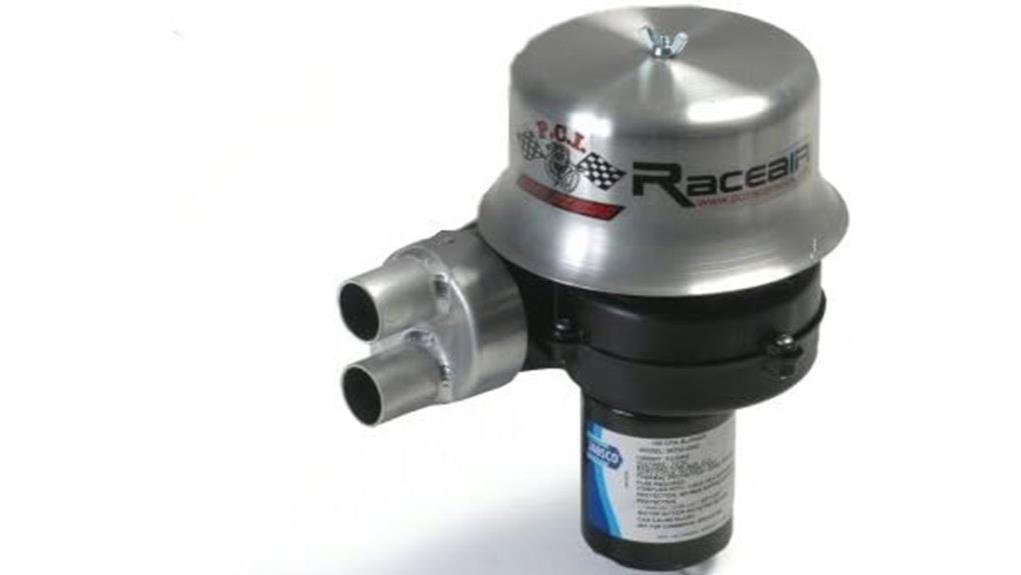
You’ll get a rugged 150 CFM dual-helmet blower that ramps airflow with engine speed and keeps pressure balanced between ports, so both helmets get consistent ventilation. It’s a compact, ~5 lb unit with an aluminum cover, short filter pre-installed, two hoses, fittings, mounting hardware and harness with inline fuse. Install on a rigid surface, keep hoses straight, and check helmet port clearance to avoid leaks or noise. Keep going and you’ll find detailed fit, install, and buying guidance.
Some Key Takeaways
- Delivers a consistent 150 CFM airflow, maintaining balanced pressure to both helmets in dual-port setups.
- Aluminum cover and polycarbonate housing improve durability and reduce resonance, though fan remains audible at high RPM.
- Includes dual hoses, helmet fittings, mounting hardware, short filter, and inline-fused wiring for straightforward installation.
- Installation quality and hose routing significantly affect peak delivery, noise, and pressure; keep hoses straight and fittings snug.
- Best for racers/endurance riders needing continuous airflow and durability; tradeoffs include five-pound weight and potential helmet-fit issues.
Real-World Performance: How the PCI Race Air 150CFM Dual Helmet System Ventilates in Practice
Typically, the PCI Race Air 150CFM dual helmet system delivers consistent airflow to both helmets, pushing up to 150 CFM through its short filter and aluminum cover while the polycarbonate housing and foam interior manage distribution and comfort. You’ll notice airflow consistency across varying engine speeds; airflow ramps linearly and maintains pressure balance between ports. Install and routing affect peak delivery, so keep hoses straight and fittings snug. Noise levels remain moderate: the aluminum cover reduces resonance, but the fan emits audible broadband at high RPM. You’ll evaluate tradeoffs between maximum flow and acceptable sound depending on helmet and rider tolerance. When selecting accessories, consider compatibility with marine battery switches to ensure reliable power management and safety.
What’s in the Box and Key Specifications for Quick Comparison
While unpacking the PCI Race Air Heavy Duty 150CFM Dual Helmet Fresh Air System, you’ll find the core components neatly organized for straightforward installation: the 150 CFM dual-port blower assembly with aluminum cover and short filter pre-installed, two supply hoses with helmet fittings, mounting hardware and brackets, a power wiring harness with inline fuse, and a basic foam gasket and user manual; the unit ships in new condition, weighs about 5 pounds, and comes in black polycarbonate housing with foam interior. For quick comparison, package specs list model pciraceair584, airflow 150 CFM, dual contents include blower plus two hoses, and condition: new. Boaters will appreciate having essential tools on hand for installation and maintenance.
Fit, Installation, and Helmet Compatibility Tips
Now that you know what’s included and the basic specs, focus on fit and installation to get reliable airflow and helmet compatibility. You’ll verify helmet sizing against manufacturer charts, checking shell and liner clearance for PCI Race Air intake ports. Mount the unit on a rigid surface, secure aluminum cover and routing to minimize choke points. Use supplied short filter and confirm dual hoses reach both helmets without kinks. Position inlets to favor chin ventilation without directing flow into the visor gap. Test with full gear, adjust hose length and clamps, and recheck seals to prevent pressure loss and noise. Consider mounting near the boat’s electrical panels to ensure a stable, vibration-free location and easy access for maintenance.
Pros, Cons, and Who Should Buy the PCI Race Air System
Because it delivers a sustained 150 CFM through a dual-outlet setup with a short filter and aluminum cover, the PCI Race Air system gives you robust ventilation that suits endurance and high-intensity racing where consistent airflow and durable construction matter. Pros: consistent 150 CFM, dual-helmet capability, aluminum cover resists heat and impact, Lightweight portability for track bags, straightforward mounting. Cons: five-pound unit adds system weight, potential fit issues with some helmet shapes, measurable Noise levels at full speed may distract. Who should buy: racers and endurance riders prioritizing continuous airflow and durability over absolute stealth and minimal mass. This system is also useful for boaters needing reliable lighting and ventilation solutions when spending nights on the water, tying into broader essential boat flashlights and safety equipment considerations.
Buying Tips: Where to Get It, Warranty, and Cost-to-Value Considerations
When shopping for the PCI Race Air Dual Helmet system, focus on authorized dealers and major motorsports retailers to make sure you get genuine parts, correct mounting hardware, and access to warranty support. Buy from authorized dealers to preserve the manufacturer part number (pciraceair584) coverage and to simplify returns if defects appear. Verify warranty length and what it covers—motor unit, filter, and aluminum cover—before purchase. Compare total cost against airflow (150 CFM), build materials, and expected maintenance to judge long term value. If price is low from unknown sellers, factor potential repair costs and voided warranty into your decision. Also consider pairing the system with compatible marine VHF radio accessories for safety and communication on the water, especially when using boats and boating gear marine VHF.
Some Questions Answered
Can the Unit Be Used With Full-Face Motorcycle Helmets?
Yes — you can use the unit with full-face motorcycle helmets, provided you verify ventilation compatibility and helmet sealability. You’ll mount the dual fresh-air outlet near your helmet intake, route the hose without kinking, and confirm seals around the hose port and visor skirt to prevent leakage. You should test airflow at riding speeds and inspect foam interfaces; if sealability is compromised, add gasket material or adjust hose position to restore effective ventilation.
Is the System Noisy at Peak 150 CFM Airflow?
Yes — at peak 150 CFM you’ll hear noticeable noise. You’ll experience elevated ambient noise as the blower runs full tilt, though perception depends on helmet insulation. The system offers airflow modulation to reduce speed and sound, so you can lower volume by dialing back flow. Expect the loudest operation during max cooling; use modulation or sound-dampening helmet liners if you need quieter performance while retaining ventilation.
How Long Does the Short Filter Typically Last Before Replacement?
You can expect the short filter lifespan to be roughly 3–6 months under regular use; heavy dust or daily track sessions shorten it to 1–2 months. You should set a replacement schedule based on operating hours and environment: inspect every 25–50 hours and replace when airflow or filtration degrades. Keep records of hours and conditions, and replace sooner if you notice reduced airflow, odors, or visible contamination for reliable performance.
Can the Aluminum Cover Withstand Track-Side Impacts?
No — the aluminum cover isn’t designed to absorb severe track-side impacts; you shouldn’t rely on it for crash protection. You’ll get moderate impact resistance against debris and light knocks, but concentrated forces can dent or deform the cover. Also note thermal expansion: repeated heat cycles can loosen fittings or change clearances, reducing protective fit. Inspect mounting hardware regularly and replace damaged covers rather than assuming continued protection.
Does the System Require a Specific Battery Voltage or Connector?
No, it doesn’t require a proprietary voltage; the system is designed for standard 12V automotive/motorcycle electrical systems. You’ll want to verify battery compatibility with your vehicle’s 12V output and confirm current supply meets the fan’s draw. Connector types used are common two-pin power leads or SAE-style plugs; you can adapt using proper gauge wiring and sealed connectors. Always match polarity and secure connections to prevent voltage drop and noise.