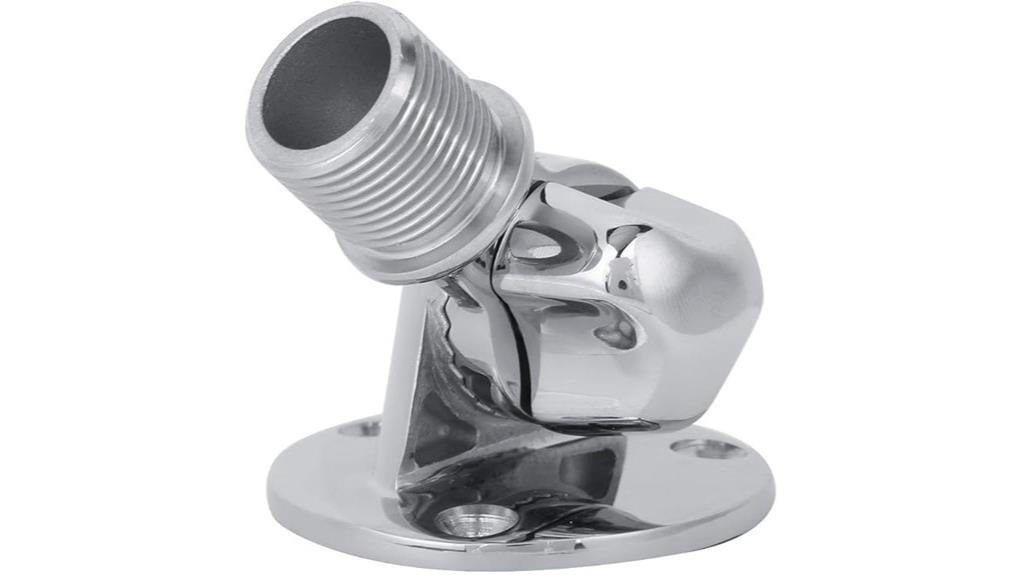
You’ll find the Thincol 316 stainless VHF antenna mount holds angle under vibration and resists salt spray, so you can trust it on sportfishers and RVs. It fits 25 mm external threads, a 65 mm base, and three 5 mm fasteners; cable routing beneath the base is recommended. The ratchet’s gear-mesh anti-skid design gives repeatable 180° positioning and secure locking. It’s heavier and costlier than alloy options, but more durable — keep going to see installation and care details.
Some Key Takeaways
- Durable 316 stainless construction resists salt spray and offers superior corrosion resistance versus aluminum or plastic mounts.
- Ratchet’s gear-meshing anti-skid design provides repeatable 180° positioning and resists slippage under vibration.
- Compact three‑hole 44 mm pattern and 25 mm external thread fit many VHF and satellite bases; verify nonstandard flanges.
- Mirror-polished finish, periodic inspection, and marine-grade lubricants reduce pitting and extend service life.
- Install with dry-fit alignment, incremental torquing of 5 mm fasteners, and cable routing beneath the base for strain relief.
How the Thincol 316 Stainless Steel VHF Antenna Mount Performs in Real Use
Installed on both a fiberglass sportfisher and a weekend RV, the Thincol 316 stainless VHF antenna mount holds position reliably and resists corrosion in salt spray. You’ll notice the ratchet’s gear-meshing anti-skid design maintains angle under vibration, keeping antenna alignment stable during transit. Field checks show no loosening after weeks of operation; user testimonials cite consistent mounting torque and low maintenance. You’ll get repeatable pointing with the 180-degree adjustment and solid three‑hole fastening. Signal strength remains steady when mounting is secure; measurements correlate with minimal deviation versus baseline. You’ll install, set, and trust this base for routine marine and RV use. For boat owners concerned about electrical system safety, proper marine battery switch selection is an important complementary consideration when outfitting your vessel.
Fit and Compatibility: Measurements, Threading, and Which Antennas It Supports
When you check fit and compatibility, start by matching the mount’s key dimensions and thread to your antenna’s specifications: the Thincol base has a 25 mm (≈1 in) external thread, a 65 mm (2.6 in) base diameter, 44 mm (1.7 in) hole centers, 5 mm mounting holes, and a maximum vertical height of ~79–80 mm (3.1 in). You’ll verify thread compatibility with your antenna’s screw fitting and confirm clearance for radome or whip bases. The 3-hole pattern suits compact VHF and many satellite receiver bases; larger commercial or nonstandard flanges may need adapters. Plan cable management beneath the base for neat, strain-free routing. This mount is a practical choice for users focused on marine VHF radios and essential boating communications.
Installation Walkthrough: Fastening, 180° Adjustment, and Ratchet Lock Tips
Before you drill or feed cable, dry-fit the Thincol 316 base to confirm hole alignment and thread engagement; this saves rework and prevents seal failures. You’ll fasten with three screws into 5 mm holes using specified mounting torque—tighten incrementally to avoid distorting the base or stripping threads. Use alignment marks to orient the bracket before final torque. For 180° adjustment, loosen the ratchet knob, set angle, then re-engage gear teeth; verify engagement by applying light axial pull. Make certain ratchet lock clicks fully; if skipped, the assembly can slip under vibration. Recheck torque after sea trials. Also consider integrating the antenna mount into your boat’s electrical panel layout to minimize cable runs and interference.
Durability and Corrosion Resistance: 316 Stainless, Polish, and Marine Wear
Although 316 stainless steel provides strong baseline resistance to seawater and chloride-induced pitting, you should expect gradual surface oxidation and micro-crevice corrosion in harsh, unmaintained environments. You’ll find that proper 316 polishing reduces initiation sites for pitting and simplifies cleaning; a mirror finish lowers surface roughness and limits chloride traps. Inspect the ratchet, threads, and mounting holes periodically for crevice corrosion and discolouration. Use marine-grade lubricants and passivation treatments to restore pitting resistance after abrasion. Fastener torque and sealing at the 3-hole interface matter: gaps concentrate salt, so maintain seals and re-polish worn areas to extend service life. For best results on boats, select mounts designed specifically for fish finder applications to ensure fit and durability.
Who Should Buy This Base and How It Compares to Alternatives
Who benefits most from this 316 stainless ratchet antenna base? You will if you need a compact, corrosion-resistant mount for VHF or satellite gear. Marine photographers and RV travelers who swap antenna angles will value the 180° ratchet, anti-skid gear, and 3-hole direct fastening for repeatable positioning. Compared to aluminum or plastic bases, this 316 unit offers superior saltwater longevity and load resistance, though it’s heavier and pricier. If weight or cost is primary, lighter alloy mounts suffice. If reliability, mirror-polished finish, and precise angling matter, choose this Thincol 316 base for long-term marine or mobile installations. Owners upgrading their T-top should consider compatible essential gear when planning the install.
Some Questions Answered
Does This Base Include Mounting Screws and Washers?
No, the base doesn’t include mounting hardware or washers. You’ll need to supply appropriate screws and washers for a secure installation. Installation tips: use 316 stainless fasteners to avoid galvanic corrosion, match the 5 mm mounting hole diameter and 44 mm center spacing, and apply threadlocker or marine-grade sealant to prevent loosening and leaks. Torque evenly across the three screws and verify vertical ratchet engagement before finalizing the fitment.
Can It Be Used on Fiberglass Without Backing Plates?
You can, but you shouldn’t rely solely on fiberglass without backing plates for secure long-term mounting. The 316 stainless base and 3-hole pattern distribute load, yet fiberglass adhesion alone risks delamination under vibration and pull. You’ll want surface sealing and structural reinforcement: drill, use marine-grade sealant around holes, and fit a backing plate or reinforcing ring inside the hull to spread loads and prevent fastener tear-out.
Is There a Warranty or Return Policy From Thincol?
Thincol doesn’t list explicit warranty terms on the product page, so you shouldn’t assume long-term coverage. Check the seller or retailer for stated warranty terms and the return process before purchase. For defects or fit issues, document photos, timestamps, and order details; contact Thincol or the seller promptly to request an RMA or return authorization. Follow their stipulated return process, retain tracking, and expect standard 30-day return windows unless otherwise specified.
Can Coax Cable Be Routed Through the Base Center?
Yes — you can route coax through the base center if your cable fits the ~25 mm external thread opening and you remove any internal plug. Use coax routing to keep runs tidy and reduce strain at the connector. Make certain antenna grounding is maintained by securing the 316 stainless base to the vessel’s common ground and using proper bonding straps; verify continuity after installation and seal around the feed for corrosion protection.
Is the Ratchet Mechanism Serviceable or Replaceable?
Yes — the ratchet mechanism is serviceable and can be replaced, but parts aren’t widely stocked. You’ll access the gear/knob by removing the top fastener, inspect the mesh teeth and anti-drop wire, then clean, lubricate, or swap worn components. Expect limited availability of official replacement parts; plan on sourcing generic stainless ratchet/knob components. Regular maintenance extends service longevity and reduces the need for full-base replacement.


