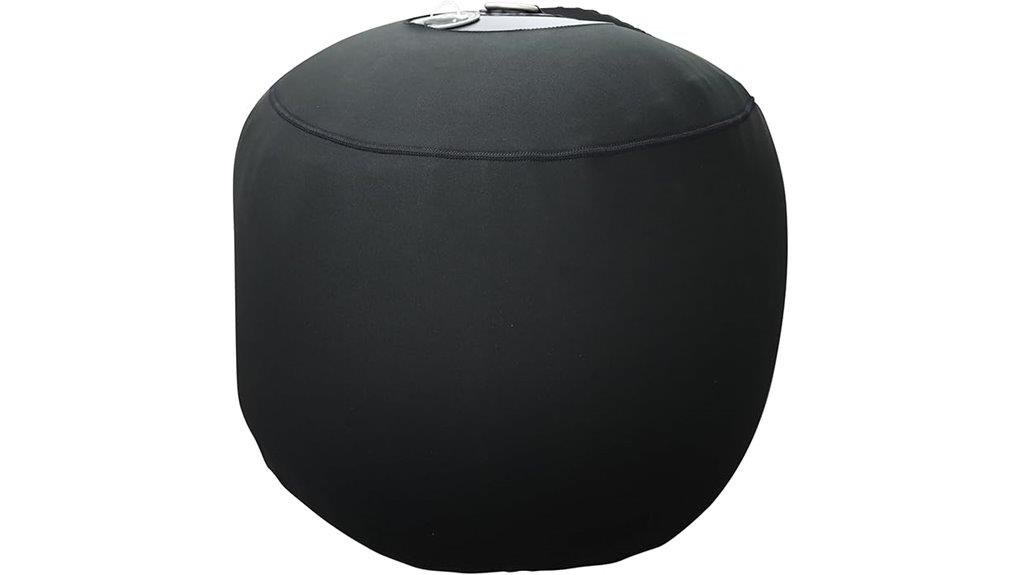
You’ll get heavy-duty, RF-welded inflatable sphere fenders with stainless tie points and a gelcoat-safe NEO cover that reliably cushion impacts and resist UV, abrasion, and punctures. Inflate to a firm-but-not-hard pressure to match your boat’s weight and contact firmness; the 36” suits higher freeboard, the 24″ fits low-profile craft. They roll up for compact storage, handle one-person placement, and justify higher cost with longevity — keep going and you’ll uncover setup, sizing, and warranty details.
Some Key Takeaways
- 36″ and 24″ inflatable sphere fenders cushion impacts, resist rolling, and distribute loads to protect hull gelcoat.
- 41 oz RF-welded PVC core with RF-welded stainless D-rings offers superior durability and UV resistance versus glued seams.
- 1.5 mm nonfibrous NEO cover prevents abrasion to gelcoat while improving energy dispersion and contact safety.
- Adjustable inflation tailors firmness and contact area for various boat weights, controlling rebound and docking behavior.
- Quick inflation/deflation, rollable storage, and corrosion-resistant tie points make handling and seasonal storage straightforward.
How the Boat Sphere Fender & Cover Works and Who It’s For
Because it’s inflatable and wrapped in a neoprene-like cover, the Boat Sphere Fender & Cover cushions impacts while keeping its shape and protecting your hull. You adjust pressure via custom inflation to match boat weight and contact firmness, so you control rebound and contact area. You’ll deploy the 36″ sphere for larger yachts or choose 24″ for smaller craft. Its shape resists rolling, distributes loads, and the cover reduces abrasion on gel coat. You’ll use it at docks, slips, or alongside other vessels; its mooring compatibility lets you rig lines or cleat-to-fender setups without complex adapters. This product is aimed at recreational boaters and marine enthusiasts who need reliable fender protection in a variety of docking situations.
Build Quality and Materials: PVC Fender, RF-Welds, Stainless Tie Points, and NEO Cover
While you’ll notice the Boat Sphere’s clean, professional finish at a glance, its durability comes from purposeful material choices: a 41 oz industrial-grade PVC shell resists punctures and UV breakdown, seams are RF-welded rather than glued to eliminate delamination points, and custom-formed stainless steel D-rings are RF-welded and backed with extra PVC strips for load distribution. You’ll appreciate the 1.5 mm nonfibrous NEO cover for abrasion resistance and gelcoat-safe contact. Construction prioritizes corrosion-resistant tie points and seam integrity to extend service life and UV resistance. Minor damage is repairable with standard PVC Repair kits, reducing downtime and cost. For those who tow frequently, choosing the right winch and accessories is essential for safe and efficient boat launching, especially when matching capacity to trailer and boat weight winch capacity.
Real-World Performance: Impact Protection, Hull Safety, Handling, and Storage
Having covered materials and construction, let’s look at how those choices perform on the water. You’ll find the 41 oz PVC sphere and NEO cover absorb and disperse energy in a dock collision, reducing point loads that damage gel coat. RF-welded seams and stainless tie points keep the fender locked in place under repeated stress, contributing to long term durability. You can inflate or deflate quickly for handling, carry and position one person-handed, then roll it for compact storage. In short, the system protects hulls reliably while simplifying deployment and stowage aboard. Many boat owners choose dock bumpers specifically designed to prevent hull damage during docking maneuvers, making dock bumpers a practical addition to any boat.
Sizing, Setup, and Installation Tips for 36″ Sphere (And Choosing Between 24″ Vs 36″)
When choosing between the 36” Sphere and the 24″ model, think about boat freeboard, expected fender gap, and handling needs: the 36″ gives you greater contact area and energy dispersion for higher freeboard boats and heavier impacts, while the 24″ suits low-profile craft or tight docking where bulk matters. For the 36″, use a controlled inflation technique—inflate to firm, but not hard, pressure and test compression against rail. Position fenders at recommended mooring placement points (bow, midships, stern) and secure stainless D-rings. Follow valve maintenance schedules, rinse and lubricate valves, and deflate before seasonal storage. Keep your boat tidy by pairing fenders with stylish marine trash cans and other onboard organization solutions like boat trash cans to maintain cleanliness and convenience.
Verdict and Buy-Or-Skip Checklist With Warranty, Price Considerations, and Alternatives
Because you want reliable hull protection without wasted bulk, the Boat Sphere 36 with NEO cover earns a solid recommendation for medium-to-large boats: its 41 oz RF-welded PVC core, stainless RF-welded D‑rings, and abrasion-resistant 1.5 mm SBR cover deliver heavy-duty impact protection while staying inflatable for compact storage. You should buy if you value durable materials, clean finishes, and compact storage. Consider warranty nuances: one-year limited coverage is standard—inspect for manufacturing defects quickly. Factor price sensitivity against longevity; higher initial cost beats frequent replacements. Skip only if budget is tight or you need minimalist, cheaper fenders. Alternatives include 24″ Sphere or traditional cylindrical fenders. Essential gear for docking includes quality dock lines and fenders to ensure secure mooring and impact protection, so remember to pair fenders with proper dock line choices.
Some Questions Answered
Is the Cover Machine-Washable?
No — you shouldn’t machine-wash the cover. For proper material care, follow wash instructions that recommend gentle hand-washing with mild soap and fresh water, then air-dry away from direct sun. You’ll avoid abrasive machines that can damage the 1.5 mm nonfibrous SBR material and seams. Spot-clean stubborn grime with a soft brush, rinse thoroughly, and store dry; that preserves finish, fit, and protective performance.
Can I Use These Fenders for Winter Storage Ashore?
Yes — you can use these fenders for winter storage ashore. Inflate them lightly to maintain shape, cover with the neoprene-like NEO cover, then position between hull and supports; they resist abrasion and won’t abrade gel coat. For winter shrinkwrap, make certain fenders sit inside the wrap to avoid compression. Combine with shoreline pest proofing measures (seal gaps, use traps) since fenders don’t deter rodents or insects on their own.
Are Replacement NEO Covers Sold Separately?
Yes — you can buy replacement covers separately. Contact Seipel Marine or your retailer to order a 1.5 mm NEO cover sized for the 36″ Sphere; they’ll confirm fit and shipping. Keep your proof of purchase and note the 1 Year limited cover warranty terms when ordering, since coverage and returns vary. If you need help locating a supplier or verifying part numbers, provide your purchase date and ASIN for faster service.
Do They Float if Accidentally Released?
Yes — they float if accidentally released. Your buoyancy testing shows the 41 oz PVC shell and inflatable air core keep the fender buoyant even with the 1.5 mm NEO cover fitted. Over time you should monitor material degradation from UV and salt exposure; compromised PVC or cover seals can reduce buoyancy. Inflate to recommended pressure and inspect seams and valves regularly to guarantee consistent floatation and reliable performance on the water.
What Pressure Should I Inflate the Sphere To?
Inflate the sphere to the recommended PSI of 2–3 psi for firm, forgiving protection. Use a low-pressure inflation method — a hand pump or low-pressure electric inflator with a gauge — and check pressure as you go. Don’t overinflate; hard fenders transmit shock. After inflating, attach the NEO cover, verify seams and D-rings, and recheck psi once installed. Store deflated for transport or long-term to preserve material.


