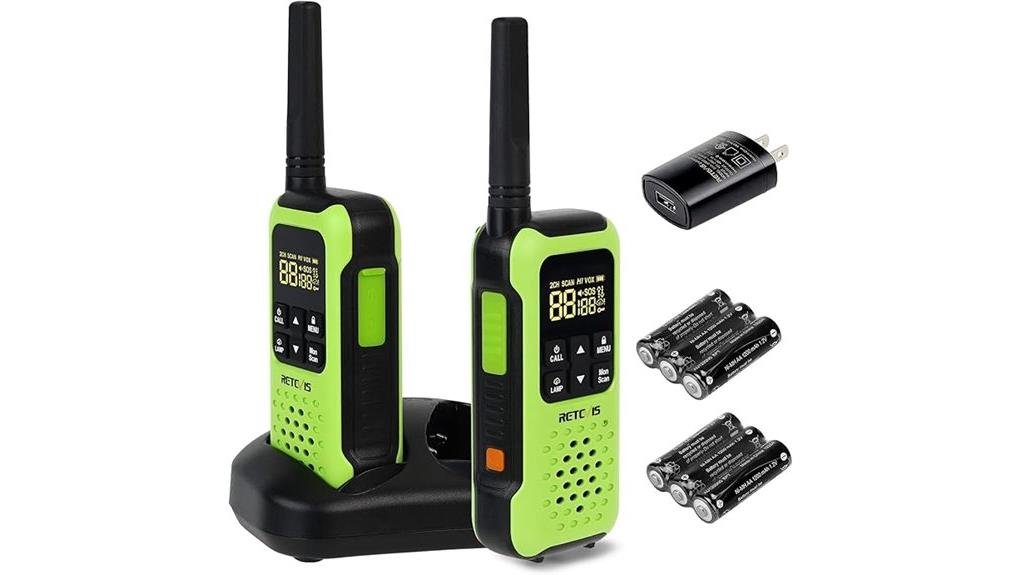
You’ll get a rugged, IP67-rated FRS pair that floats, flashes a water-activated LED, and resists drops and salt spray for boating or kayaking. Channels cover standard 22 FRS frequencies with NOAA alerts and SOS for weather and distress. Expect about 1–6 miles line-of-sight range depending on terrain, with a hot‑swappable 6×AA NiMH pack giving roughly 12 hours real-world use and USB charging. If you want reliable, visible marine-ready comms, keep reading to see specifics and tradeoffs.
Some Key Takeaways
- Rugged, IP67-rated FRS radios that float and include a water-activated LED for quick recovery if dropped overboard.
- Operate on 22 FRS channels with up to 2 watts, offering typical ranges of 1–5 miles, up to 6+ over open water.
- NOAA weather alerts and SOS functions provide critical weather and distress notifications for boating and outdoor safety.
- Uses a hot‑swappable 6×AA NiMH 1200 mAh battery pack (~12 hours real-world), with USB/tray charging for day-trip top-ups.
- Best for recreational boaters/kayakers needing waterproof reliability and visibility; not for extended-range or GPS-equipped professional use.
Quick Verdict : Is the Retevis RT49P Worth Buying?
While you won’t get pro-grade radio features, the Retevis RT49P delivers a tough, waterproof, and highly visible FRS pair that’s ideal for boating, kayaking, and general outdoor use. You’ll appreciate the clear value proposition: rugged IP67 sealing, floatable design, LED retrieval light, NOAA alerts, and a usable 1–6 mile range depending on conditions. Battery life, included charger, and FRS compatibility keep logistics simple. For recreational boaters, coastal anglers, and campsite teams the radios cover core user scenarios without complexity. If you want reliable, low-maintenance comms for water and trail use, these are worth buying. Consider how handheld marine radios simplify safety and coordination on boats and waterways.
Waterproof, Flotation, and Durability Tested : How It Holds Up Outdoors
Because you’ll be relying on these radios where water, drops, and rough handling are likely, the RT49P proves its credentials: IP67 sealing keeps them submerged to 1 meter for 30 minutes, the buoyant housing guarantees they float if you drop one overboard, and the water-activated LED makes retrieval straightforward. You’ll get predictable waterproof performance in wet sports and sudden downpours. The heavy-duty, impact-resistant shell and non-slip grip deliver reliable impact resistance for tackles, slips, and accidental drops. Floatation reliability is excellent—bright fluorescent housings aid visual recovery—and the led retrieval feature actually speeds finding a submerged unit. These features make the RT49P a practical choice for boating enthusiasts.
Range, Channels, and Communication Features You’ll Actually Use
If you need dependable short-range comms on the water or trail, the RT49P delivers with FRS operation across 22 channels and the maximum legal 2-watt transmit power, giving you typical ranges from about 1–5 miles depending on terrain (up to 6+ miles over open water, shorter in urban or wooded areas). You’ll use channel scanning to find clear frequencies, and NOAA alerts to stay ahead of weather. SOS functionality gives a simple distress trigger. Transmission clarity is surprisingly good for FRS gear—voice comes through cleanly unless terrain or buildings block line-of-sight. Practical, no-nonsense comms. The site also offers a range of marine VHF radio accessories ideal for boating, including mounting kits and waterproof speakers for safer on-deck communication with marine VHF radios.
Battery, Charging, and How Long It Lasts in the Field
Typically, you’ll get about 12 hours of real-world use from the RT49P’s 6×AA NiMH 1200 mAh pack, which balances decent runtime with hot-swappable convenience. You charge via the included USB cable and drop-in tray; top-ups are straightforward and quick enough for day trips. Expect gradual capacity loss over many recharge cycles—plan for eventual Battery replacement after heavy use. Use built-in power saving settings and mute when idle to stretch runtime. Cold performance is solid down to -20 °C but you’ll see reduced runtime in extreme cold; keep spares warm and swap batteries as needed. For boating and nighttime safety, pair the radios with reliable boat flashlights for safer nights on the water.
Who Should Buy the RT49P and Which Alternatives to Consider
When you need a rugged, waterproof pair of FRS radios that float and keep working through surf, spray, or a sudden dunk, the RT49P is a strong, no-nonsense choice for boaters, kayakers, anglers, and anyone who prioritizes reliability and visibility on the water. You should buy it if you want IP67 submersion protection, floating recovery, NOAA weather alerts, and long battery life without breaking the bank — great for budget buyers and family trips. Consider alternatives if you need extended range, commercial PMR446/GMRS compatibility, or integrated GPS; look at higher-power GMRS sets or marine VHF for professional use. For buying accessories and related products, check out our site for weather radio options and boating gear.
Some Questions Answered
Can These Radios Pair With FRS Devices From Other Brands?
Yes — you can pair them with other FRS devices. They use standard FRS compatibility and the 22 FRS channels, so you’ll match channels and CTCSS/DCS tones if needed. Use Channel mapping to make certain both radios share the same channel and privacy code; scan or manually set the channel. Remember range and obstructions vary by environment, and full interoperability requires other radios to follow FRS rules and support the same tone settings.
Are Replacement Batteries or AA Nimh Packs Available Separately?
Yes — replacement batteries and AA NiMH packs are available separately. You can buy the same 6×AA NiMH 1200 mAh packs from Retevis or reputable retailers; battery availability is good. You can also use third party swaps (compatible AA NiMH cells) but stick to similar capacity and low self-discharge types to preserve runtime and charging behavior. Always follow manufacturer specs and test new packs before critical outings.
Is the LED Light Manually Operable or Only Water-Activated?
The LED light is primarily water-activated but you’ll also get a manual toggle for control. You can switch between light modes (steady, strobe, SOS) via the radio’s button, so you’re not limited to buoy-recovery activation. That manual toggle gives you on-demand illumination and emergency signaling, while water activation guarantees automatic visibility if the unit hits the water. You’ll appreciate the flexible, user-focused lighting options in outdoor scenarios.
Does the Package Include a Car Charger or Multi-Bay Charger?
No, the package doesn’t include a car charger or a multi-bay charger. You get a USB charging cable, adapter and a drop-in charging tray for the pair, plus belt clips and a user manual. If you need mobile or fleet charging, you’ll have to buy a separate car charger or multi-bay unit. You can also add a compatible shoulder mic for hands-free use; it’s sold separately and connects to the FRS-compatible accessory port.
Can the Radios Be Used Legally for Commercial Purposes?
Yes — you can use them for some commercial tasks, but you shouldn’t assume unrestricted use. They operate on FRS frequencies with frequency compliance for unlicensed consumer/business short-range operations, so you don’t need a commercial licensing for typical site-to-site coordination. If your operation requires higher-power GMRS/licensed channels, encrypted comms, or fixed infrastructure, you’ll need proper commercial licensing and approved frequencies. Check local regulations before wide commercial deployment.