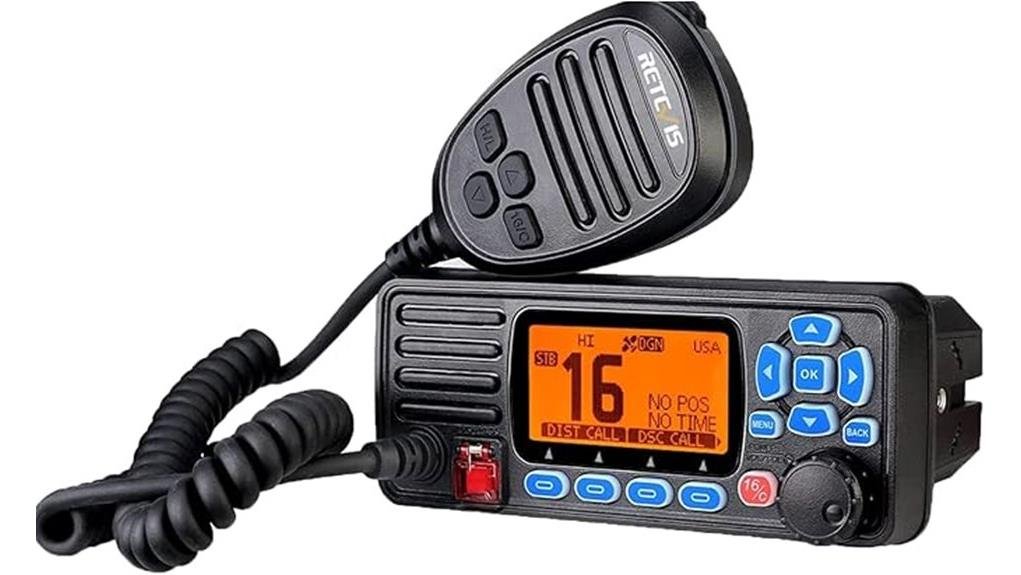
You’ll find the Retevis RA27 is a compact, IP67-rated fixed-mount VHF that gives you DSC/GPS distress, Triple Watch channel monitoring, and robust voice links for coastal use. It’s built for bulkhead or console mounting with a low-strain chassis and serviceable cabling. Audio and AGC are clear, GPS fixes are prompt, and NOAA alerts are supported. Power and standby draw suit continuous monitoring. Keep going to see detailed installation notes, performance data and alternatives.
Some Key Takeaways
- Compact fixed-mount VHF with DSC and built-in GPS offering reliable distress transmission and position sharing.
- IP67 waterproofing and robust mount kit enable bulkhead/console installation and immersion resistance when sealed.
- Triple Watch and NOAA weather alerts support continuous monitoring and timely safety notifications.
- Strong transmit power, sensitive receiver, and clear audio deliver dependable ship-to-ship and ship-to-shore communication.
- Good value for cruisers and commercial users seeking essential safety features without premium networking or AIS options.
Retevis RA27 at a Glance: Core Specs and What Sets It Apart
When you install the Retevis RA27, you get a fixed-mount VHF marine radio that combines high transmit power, full international/US/Canada channel coverage, and a Triple Watch function for simultaneous monitoring of three channels. You’ll appreciate compact engineering: IP67 sealing, lightweight chassis, and a mount kit for fixed installation. Core specs emphasize marine connectivity with complete channel support, robust transmitter output, and DSC-ready circuitry (details later). User controls and dot-matrix LCD simplify operation. Power options include standard 12V DC supply with low-current standby and protection circuitry for marine electrical environments. Installation is straightforward and serviceable. For buyers seeking guidance on handheld versus fixed radios, consider basic essential tips to match the radio to your boating needs.
Real‑World Performance: Range, Audio Quality, DSC Distress, and GPS Reporting
Although conditions vary with antenna height and environment, you’ll reliably get long-range VHF performance from the RA27 thanks to its high transmit power and efficient receiver sensitivity. In practice you’ll achieve clear ship-to-ship and ship-to-shore links at typical coastal distances; range depends on antenna placement and line-of-sight. Audio is intelligible with low distortion and robust AGC handling; microphone clarity reduces repeat transmissions. DSC distress works promptly—distress calls include GPS coords and preformatted MMSI data—while GPS reporting is accurate. You shouldn’t notice perceptible signal latency. Standby draws are modest, so continuous monitoring won’t cause undue battery drain on auxiliary power. The RA27 is a solid choice for recreational boaters who need reliable communication and marine VHF basics for safer trips.
Installation and Usability: Mounting, Waterproofing (IP67), Display, and Controls
How straightforward is mounting the RA27 on your vessel? You get a compact unit with robust mounting hardware and a supplied bracket that secures to bulkhead or console with four screws. Installation’s quick; cable routing and chamfered base reduce strain. IP67 waterproofing means the head unit tolerates immersion and resists spray — seal connectors and gasketed housings are effective if you follow torque specs. The dot-matrix LCD provides clear readouts in daylight and low light. Controls are logically grouped; button ergonomics favor gloved use with positive tactile feedback. Overall, setup and daily operation are efficient and predictable. For boats, choosing an appropriate marine battery switch helps ensure reliable power management and complements the RA27’s dependable operation.
Safety, Navigation, and Weather Features: DSC, NOAA Alerts, GPS, and Position Sharing
Because the RA27 integrates DSC, GPS, and NOAA weather alerts into a single unit, you get a compact safety and navigation hub that can both warn you of hazards and share your precise position with responders. You’ll trigger DSC distress with one button, transmitting MMSI-coded alerts and coordinates for emergency interoperability with vessels and coastguard units. Built-in GPS provides real-time position and manual entry fallback; you can share fixes to other radios or external devices. NOAA weather alerts are automatic and persistent. Controls let you suppress position broadcasts to protect position privacy when operational security is required. The RA27 is a practical choice for recreational boaters who want essential marine safety features in a fixed-mount radio with compact integration.
Who Should Buy the RA27 and Alternatives to Consider
If you need a fixed-mount VHF that combines reliable long-range transmit power, integrated DSC/GPS distress capability, and persistent NOAA weather alerts, the RA27 is a strong choice for cruisers, commercial operators, and serious day-sailors who value compact installation and straightforward operation. You’ll appreciate its Triple Watch, IP67 durability, and position-sharing for safety. Buy the RA27 if you’re a coastal cruiser, small-fleet operator, or budget buyers seeking capability without premium cost. Alternatives: prioritize taller performance or features—consider Icom M330 for advanced DSC/networking, Standard Horizon GX2200 for ergonomics and AIS options, or Garmin VHF models for integrated charting. The site focuses on essential emergency radios for safe boating adventures and product selection tailored to mariners seeking reliability and safety at sea, including essential emergency radios.
Some Questions Answered
Does RA27 Support MOB (Man Overboard) Rapid Marking?
Yes — you can rapidly mark a MOB position. You’ll follow the MOB procedure using the RA27’s DSC distress capability and built‑in GPS to create an Emergency beacon with position data. You’ll manually trigger DSC distress or send a position report to other vessels; the radio also supports sending coordinates to external devices. Use the rapid MOB workflow to broadcast your location, alert nearby craft, and enable coordinated rescue.
Can Radios Be Networked for Group GPS Tracking?
Yes — you can network radios for group GPS tracking. You’ll use DSC and GPS position exchange to enable fleet tracking and beacon sharing among compatible units. Radios send periodic position reports or distress beacons with coordinates; a central vessel or shore station aggregates locations. Make certain all units support DSC position messaging and external GPS input, and configure channel, reporting intervals, and permissions to maintain synchronized, secure tracking across the fleet.
Is Firmware Updatable by the User?
Yes — firmware updateability exists, but user flashing is limited. You can receive official firmware from the manufacturer and perform user flashing via their approved USB or PC tool per instructions. You shouldn’t attempt unofficial firmware or unsupported methods, as that voids warranty and risks bricking the unit. Follow Retevis procedures for backup, correct version selection, and checksum verification to guarantee safe, reliable updates and preserve DSC/GPS functionality.
What Warranty and Service Options Exist?
You get a standard limited Warranty length—typically one year from purchase covering defects in materials and workmanship. You’ll need proof of purchase for claims. Service centers authorized by the manufacturer handle repairs, warranty replacements, and firmware updates; contact support for RMA instructions and nearest Service centers. Out-of-warranty repairs are available for a fee. You’re responsible for shipping unless otherwise specified; unauthorized modifications void the warranty.
Are There Privacy Controls for Shared Position Data?
Yes — you can control position privacy via sharing settings. You’ll disable or enable automatic position broadcasts, restrict DSC position requests, and choose manual transmission of GPS coordinates. The radio supports selective position exchange with compatible units and external GPS devices, so you’ll limit recipients and frequency of updates. Review menu options and DSC configuration to guarantee only authorized vessels or stations receive your coordinates, preserving operational privacy and security.